















In-Depth Look at the Thai Labor Market in 2026: Why Traditional Job Postings No Longer Attract Applicants
As Thailand enters 2026, the labor market is no longer operating under the same rules. Many organizations are facing what is often called “The Great Mismatch”—job vacancies remain open, yet few candidates apply, and those who do often fail to meet expectations.
This challenge persists even when companies offer competitive salaries, standard benefits, and have long-established operations. The issue is not that people are unwilling to work, but rather that the Thai labor market has fundamentally shifted in 2026.
The Thai Labor Market in 2026: From Employer-Driven to Candidate-Driven
The market is rapidly shifting from an employer-driven model to a candidate-driven market, particularly in roles requiring specialized skills such as engineering, IT and digital functions, B2B sales, and language-based positions (Japanese, English, or Chinese).
Traditional job postings—listing duties, lengthy qualifications, and ending with “Please send your resume”—may look complete, but they miss a critical element: the candidate’s motivation.
These postings fail to answer essential questions candidates now ask:
-
How will this job improve my career or lifestyle?
-
Why should I choose this company over others hiring for the same role?
-
What is the team, leadership, and work environment really like?
As a result, strong candidates choose not to apply, while applicants who do often fail to align with organizational needs.
Reference : BOT
Why Traditional Job Descriptions No Longer Work
1.1 The Candidate-Centric Market With Gen Z fully entering the workforce, job seekers are no longer looking for “just a job.” They seek purpose, growth, and lifestyle fit. Job postings that focus only on company requirements—without highlighting development opportunities or work culture—are quickly ignored.
1.2 Employer Credibility in the Digital Age Candidates routinely research employers through social media and review platforms before applying. Companies with little online presence or outdated employer images quickly lose credibility—regardless of salary or benefits.
1.3 Skill Gaps and Passive Talent Many roles in 2026 require highly specialized skills, such as advanced data analytics or AI-related expertise. These professionals are often passive candidates—already employed and not actively searching on job boards. Reaching them requires proactive strategies beyond traditional job postings.
Today’s workforce evaluates opportunities holistically. Salary alone is no longer enough. Culture, long-term growth, work-life balance, and employer reputation all play a critical role. If an organization cannot clearly answer the question “Why should I choose this company?”, even a well-paid position is likely to be overlooked.
Reference: https://th.hrnote.asia/hrinsight/candidate-centric-recruitment-250729/
Employer Branding: The Key to Attracting Today’s Workforce
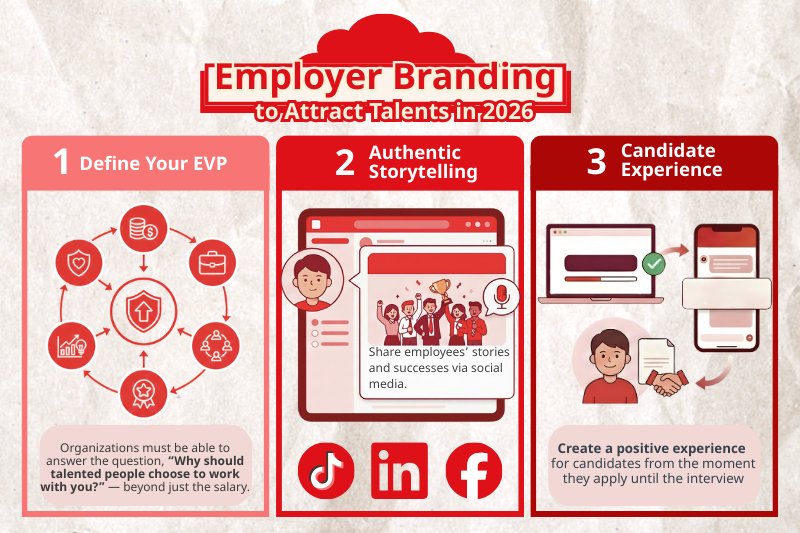
Employer Branding is not about appearance alone—it is about clearly and authentically communicating who you are as an employer. As candidates no longer choose jobs based solely on salary, Employer Branding is no longer optional. It has become a critical strategy for attracting and retaining quality talent.
How to Build Employer Branding in 2026
1. Define Your EVP (Employee Value Proposition) Organizations must clearly answer: “Why should top talent work here?” Beyond salary, this includes work culture, mental health support, and learning opportunities.
2. Authentic Storytelling Replace stock photos with real employee stories. Sharing authentic experiences on platforms like LinkedIn or TikTok helps candidates understand the real work environment and company culture.
Recruitment Agencies: More Than Hiring Support
Recruitment agencies play an increasingly important role—especially for Japanese companies in Thailand—where traditional job postings fail to reach skilled candidates. In 2026, their value lies in speed, quality, and risk reduction.
Why Recruitment Agencies Matter
1. Access to Passive Talent Top professionals are rarely active job seekers. Agencies leverage strong networks and talent pools to directly approach and engage these candidates.
2. Deep Screening & Curation With AI-generated resumes becoming common, agencies evaluate both technical skills and cultural fit to ensure candidates are truly suitable—not just impressive on paper.
3. Market Insight Agencies provide market advice, such as realistic salary benchmarks and improvements to job descriptions, helping companies stay competitive.
4. Candidate Experience The recruitment journey reflects the employer brand. Agencies help ensure smooth communication and a positive candidate experience throughout the hiring process.
How Organizations Must Adapt
Successful hiring in 2026 requires an integrated approach. Employer Branding attracts interest, while recruitment agencies deliver the right talent. If your organization still relies on traditional job postings with little response, it is time to reassess your recruitment strategy. In Thailand’s 2026 labor market, hiring is no longer about posting and waiting—it is about strategy and execution.
Reference : Empeo , Blog.jobthai , th.hrnote.asia
About us

Personnel Consultant , We’re Japanese recruitment company in Bangkok. We has been in the business of recruiting Thai and Japanese talent for 30 years.
Companies looking for talent & staffing , please contact us through this form Click
Tel.02-2608454
Email : jobs@personnelconsultant.co.th
Contact & Follow Us