














Personnel Consultant , We conducted the Salary Survey & Benefits 2025, focusing on key HR-related data such as salary structures, benefits, and employment trends among Japanese companies operating in Thailand. This survey was conducted with the cooperation of 926 Japanese companies across a wide range of industries, including manufacturing, automotive, electronics, logistics, IT, services, and international trading. The data was collected between September 26 and October 14, 2025, with the objective of providing valuable insights into compensation structures, employee benefits, and HR-related trends within Japanese companies in Thailand.
Salary Trends by Job Function
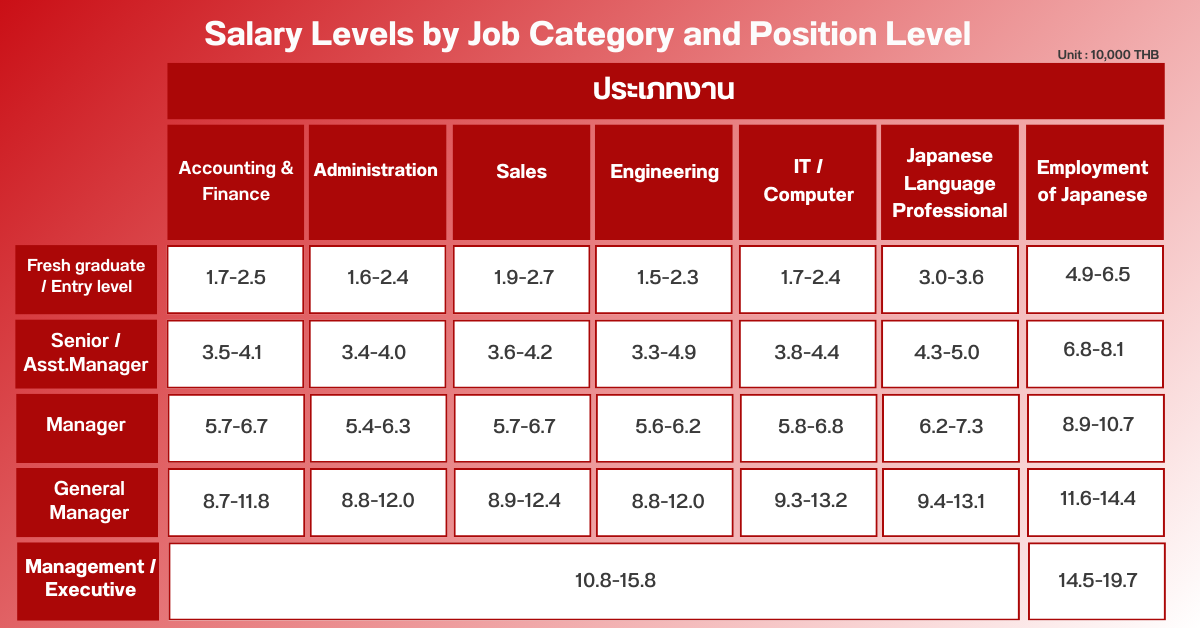
The survey categorizes salaries into seven major job functions, including Japanese expatriates and employees with Japanese language proficiency. Overall salary levels in 2025 remain relatively stable compared to the previous year. However, a notable change was observed at the executive level, particularly among General Manager (GM) positions, where salaries increased across all job functions. The IT sector recorded the most significant growth, with GM-level salaries rising by THB 11,000–27,000, showing the highest level of volatility.
**Compared with the Salary Survey & Benefits 2024
1.Overview of salaries in various fields at Japanese companies in 2025
◆ Accounting & Finance
Accounting is a licensed profession requiring CPD certification. Entry-level salaries range from THB 17,000–25,000. Candidates with language skills, particularly Japanese or English, can expect compensation above the market average.
◆ Administration & Management
Administrative and management roles typically start at THB 16,000–24,000. Professionals with experience in overall management or labor union relations may earn over THB 60,000.
◆ Sales
Sales positions offer starting salaries of THB 19,000–27,000. Many companies emphasize commission schemes and incentive bonuses to drive new customer acquisition.
◆ Engineering
Entry-level engineering salaries range from THB 15,000–23,000. There is strong demand for engineers with Japanese and English communication skills. Japanese fresh graduates working in Thailand may receive starting offers of THB 30,000 or higher.
◆ Information Technology (IT)
IT remains the most in-demand job category. Entry-level salaries range from THB 17,000–24,000. However, Japanese companies face increasing challenges competing with Thai and Western firms in terms of compensation levels.
◆ Japanese Language Professionals
Employees with Japanese language proficiency earn, on average, 1.8 times higher salaries than those in general roles.
JLPT N3: THB 23,000–25,000
JLPT N2: THB 25,000–30,000
JLPT N1: THB 30,000–35,000
Most companies prefer candidates with JLPT N2 or above.
◆ Employment of Japanese Nationals
Local hiring of Japanese nationals shows a slight decline, with most companies employing 1–2 Japanese staff members. The most common roles are Sales (47%) and Executive positions (31%). The decrease is mainly due to fewer expatriate assignments from Japan and difficulties in sourcing suitable candidates locally.
◆ Thai Directors & Senior Executives
While salaries for Thai directors and senior executives increased during 2023–2024, the 2025 survey shows a minimum base salary decrease of THB 8,000 compared to the previous year.
Although many Japanese companies continue to promote localization by appointing capable Thai executives, internal promotion remains a common and natural pathway in many organizations.
**Source: Salary & Benefits Statistics of Japanese Companies in Thailand 2025, Personnel Consultant Co., Ltd.
2.Salary Increase , Bonuses and Benefits

◆ Salary Increase
Annual salary increases for 2025 and projections for 2026 mostly fall within 2.0–3.9%, with a median of 3.0% across both manufacturing and non-manufacturing sectors.
Manufacturing companies show more consistent salary adjustments, while non-manufacturing sectors report a higher proportion of companies with no salary increase (8%) or undecided plans (21%), reflecting cautious compensation strategies.
◆ Bonus Payments
For fiscal year 2024 and projections for 2025, the average bonus payment remains at 2.4–2.5 months. Manufacturing companies have a higher proportion of employees receiving bonuses of 3 months or more. Over half of the companies maintained the same bonus level year-on-year, while reductions—mostly within 1–20%—reflect economic adjustments, particularly in non-manufacturing sectors.
◆ Allowances & Benefits
Across industries, health checkups, health insurance, and transportation allowances remain core benefits. Manufacturing companies offer higher coverage for attendance allowances, meal allowances, and provident funds, while non-manufacturing sectors focus more on sales-related benefits such as mobile phone allowances and special incentives.
Job seekers increasingly prioritize benefits, prompting companies to enhance benefit packages to attract qualified talent.
◆ Recruitment Challenges
Sales and production engineers are the most difficult positions to fill in the manufacturing sector. In non-manufacturing industries, 44% of companies report difficulty hiring sales personnel.
The most effective recruitment channel remains recruitment agencies (67–69%), followed by external job portals and employee referrals—highlighting the growing challenge of sourcing specialized talent in today’s labor market.
References : humansoft , Blog.jobthai
For the full Salary & Benefits Survey of Japanese Companies in Thailand 2025, please contact:
Tel: 02-260-8454
Email: jobs@personnelconsultant.co.th
About us

Personnel Consultant , We’re Japanese recruitment company in Bangkok. We has been in the business of recruiting Thai and Japanese talent for 30 years.
Companies looking for talent & staffing , please contact us through this form Click
Tel.02-2608454
Email : jobs@personnelconsultant.co.th
Contact & Follow Us