















Employers Should Know! What Has Changed in Thailand’s Labor Laws in 2026?
1. Minimum Wage
The government has announced an increase in the minimum wage nationwide, effective 1 July 2025. The new minimum wage varies by location, ranging from THB 337 to THB 400 per day. The areas with the highest minimum wage of THB 400 per day include Bangkok, Phuket, Chachoengsao, Chonburi, Rayong, and Koh Samui District in Surat Thani. More information on minimum wage rates
The increase aims to improve employees’ quality of life. At the same time, it presents a cost-management challenge for HR teams, who need to review and adjust salary structures to comply with the latest labor regulations, particularly in areas with the highest minimum wage, such as Bangkok and other major economic provinces.
2. Maternity Leave Rights
Another major highlight of Thailand’s labor law changes is the expansion of maternity leave and family-related leave rights, benefiting both female employees and their spouses.
● Maternity leave: Increased from 98 days to 120 days, including prenatal leave and holidays during the leave period. Employees are entitled to receive wages for up to 60 days.
● Additional leave for a sick or disabled child: Employees may take an additional 15 days of leave, with 50% of wages paid.
● Spousal leave to help care for a newborn: Spouses may take 15 days of leave within 90 days after childbirth, with 100% of wages paid.
Employers therefore need to carefully plan workforce capacity, as an employee may be absent for nearly four months, which could affect the company’s workflow and operations.
3. New Social Security Contribution Ceiling
Another important change affecting both employers and employees is the adjustment of the maximum wage base used to calculate Social Security contributions.
The maximum salary base has been increased from THB 15,000 to THB 17,500, resulting in changes to the 5% contribution as follows:
● For a salary base below THB 17,500, the contribution is calculated at 5% of actual wages.
● For a salary base of THB 17,500 or more, the maximum contribution is THB 875 per month.
4. Employee Welfare Fund (EWF)
The Employee Welfare Fund was established to provide financial protection for employees in cases such as termination of employment, death, or retirement, particularly where an employer is unable to provide statutory compensation or other benefits required under labor law. The requirements include:
● Businesses with 10 or more employees
● Businesses that do not have a Provident Fund
● If a company has a Provident Fund but some employees are not members—for example, employees during their probationary period—the employer must arrange for those employees to participate in the Employee Welfare Fund.
The contribution rates are as follows: From 1 October 2026 to 30 September 2031, both employees and employers will contribute 0.25% of wages. And from 1 October 2031 onwards, both employees and employers will contribute 0.50% of wages.
Other Important Labor Law Requirements
There are also other labor law requirements that employers should be aware of, including rules concerning employment contracts and termination of employment.
● Employment Contracts Under the latest labor regulations, employers should prepare written employment contracts clearly specifying key details such as the employee’s position, wages, benefits, and other employment conditions.
Termination of Employment In the case of termination under an indefinite-term employment contract, employees are generally entitled to advance notice of at least one wage payment period. Alternatively, the employer may provide payment in lieu of notice.
However, this requirement may not apply in cases of serious misconduct, such as fraud or intentionally causing damage to the employer. In such cases, the employer may terminate employment immediately without advance notice and without paying statutory severance, subject to the legal conditions.
● Severance Pay Thailand’s labor law continues to establish statutory severance pay based on an employee’s length of service. Employees who have worked for at least 120 days but less than one year are entitled to severance pay of at least 30 days of their final wage rate.
The entitlement increases according to length of service, up to a maximum of 400 days of the final wage rate for employees who have worked for 20 years or more.
Understanding these rates is important for organizations when planning their financial resources and HR budgets.
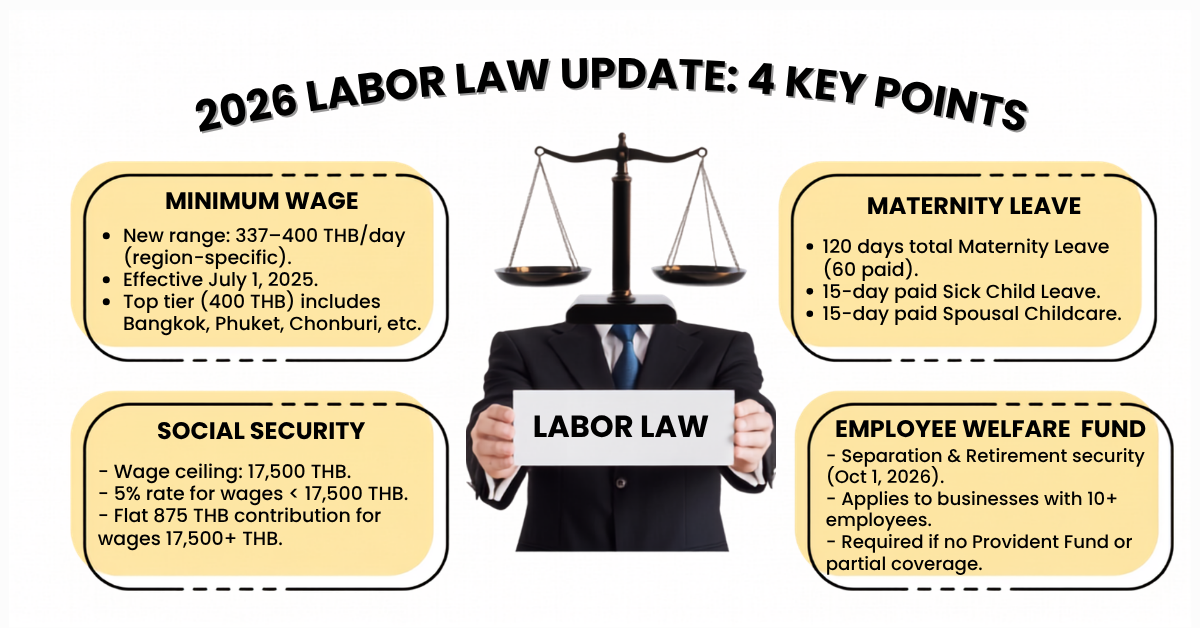
4 Key Labor Law Updates Employers Should Know in 2026
Minimum Wage: Bangkok and designated major economic provinces have a minimum wage of THB 400 per day, effective 1 July 2025.
Social Security: The maximum contribution base has been increased, with the maximum contribution stated as THB 875 per month.
Maternity Leave: Employees are entitled to 120 days of maternity leave, with wages paid for up to 60 days. An additional 15 days of leave is available when a child is sick or disabled, with 50% of wages paid. Spouses may take 15 days of leave to help care for a newborn, with 100% of wages paid.
Employee Welfare Fund: Companies without a qualifying Provident Fund are required to contribute to the Employee Welfare Fund in accordance with the law, starting 1 October 2026.
2026 is another important year for labor law developments in Thailand. Key changes include updates to the minimum wage, expanded family and maternity leave rights, the adjustment of the Social Security contribution ceiling, and the introduction of Employee Welfare Fund contributions.
These changes directly affect both employer costs and employee benefits. Business owners, employers, and HR professionals should therefore stay up to date with the latest regulations and review their HR policies, workforce planning, and payroll systems to ensure compliance, reduce legal risks, and support long-term stability for both the organization and its employees.
Sources
About us

Personnel Consultant , We’re Japanese recruitment company in Bangkok. We has been in the business of recruiting Thai and Japanese talent for 30 years.
Companies looking for talent & staffing , please contact us through this form Click
Tel.02-2608454
Email : jobs@personnelconsultant.co.th
Contact & Follow Us