










Workforce Planning: A Practical Guide for HR
A company may have enough employees today but still face staffing challenges in the future. Business expansion, new technology, employee turnover, and changing customer needs can all affect the people and skills an organization requires.
When companies plan only around immediate vacancies, HR may have limited time to find suitable candidates or prepare employees for new responsibilities.
Workforce planning helps companies look beyond their current staffing needs. It connects business goals with decisions about employee numbers, skills, recruitment, and development.
For HR teams, the aim is not simply to hire more people. It is to understand what the business may need, identify potential problems early, and choose practical ways to prepare the workforce.
What Is Workforce Planning?
Workforce planning is the process of assessing a company’s current workforce and preparing for its future staffing and skill requirements.
It considers questions such as:
- Does the company have enough employees for its business plans?
- Do employees have the skills needed for upcoming changes?
- Which roles may be difficult to fill?
- Should the company recruit new employees or develop its existing workforce?
The answers help HR and managers make informed decisions about hiring, training, internal transfers, and workforce costs.
Workforce planning can be useful for companies of different sizes. A small business may use it to prepare for expansion, while a larger organization may use it to plan staffing needs across several departments.
Why Should HR Plan for Future Workforce Needs?
Workforce planning helps HR make decisions with a clearer understanding of the company’s direction.
1. Prepare for recruitment needs
HR can identify positions that may be needed in the coming months and prepare recruitment plans before vacancies become urgent.
2. Identify skills that need development
Companies can find out whether employees need additional training to support new technology, work processes, or business goals.
3. Make better use of existing employees
Before opening new positions, managers can review whether current employees have the skills or potential to take on different responsibilities.
4. Plan workforce costs
Early planning helps companies consider recruitment, training, and other staffing costs when preparing their budgets.
5. Support business changes
When a company expands, introduces new services, or changes its operations, workforce planning helps HR understand how those changes may affect staffing and skills.
The results depend on the information available and how effectively the company follows its plan. Workforce planning supports better decisions, but it cannot remove every hiring or staffing challenge.
Four Questions to Guide Workforce Planning
Rather than starting with a target number of new hires, HR can use four questions to understand what the company needs and decide what to do next.
1. What Does the Business Need to Achieve?
Workforce planning should begin with the company’s business direction.
For example, a company planning to enter a new market may need more sales employees, language skills, or customer support. A manufacturer introducing new equipment may need employees who can operate and maintain the technology.
HR should discuss upcoming plans with department managers and identify changes that could affect staffing.
These may include:
- Opening new branches or expanding operations
- Introducing new products or services
- Changing technology or work processes
- Increasing or reducing business activity
- Preparing for expected employee turnover
Understanding these changes gives HR a clearer starting point for workforce decisions.
2. What Can the Current Workforce Do?
The next question is whether the company already has the people and skills needed to support its plans.
HR can review employee numbers, job responsibilities, work experience, training records, and available skills. Discussions with managers can also help identify areas where teams may need additional support.
For example, a company may plan to use a new digital system. Some employees may already have the necessary skills, while others may need training.
This review helps the company understand what it can achieve with its current workforce before deciding whether external recruitment is necessary.
3. Which Gaps Need Attention First?
After reviewing business needs and current capabilities, HR can identify the areas where the two do not match.
These gaps may involve employee numbers, technical knowledge, language ability, management experience, or other job-related skills.
For example, a company may have enough employees overall but lack experienced supervisors for a new production line. Recruiting more entry-level employees may not solve this problem. The company may need to develop existing employees while also looking for experienced candidates.
Not every gap requires immediate action. HR and managers should consider the effect of each gap on daily operations, future projects, and business priorities.
This helps them focus their time and budget on the most important needs.
4. Which Solution Fits the Situation?
Once the priorities are clear, HR can work with managers to decide how to address them.
Possible options include:
- Recruitment: Hire new employees when the required skills or experience are not available internally.
- Training and development: Help existing employees build the skills they need.
- Internal mobility: Move employees into roles that better match their capabilities and the company’s needs.
- Work redesign: Review responsibilities and processes to improve how available employees are used.
- Temporary workforce support: Bring in additional staff for short-term projects or periods of higher demand, where appropriate.
Companies may need a combination of these options. The right choice depends on the urgency of the need, the available budget, the skills required, and the time needed to prepare employees.
How Can HR Turn Workforce Planning Into an Action Plan?
Once HR understands the company’s needs, the next step is to turn that information into clear actions.
A practical workforce plan does not need to be complicated. HR can start with a simple table that department managers can review and update.
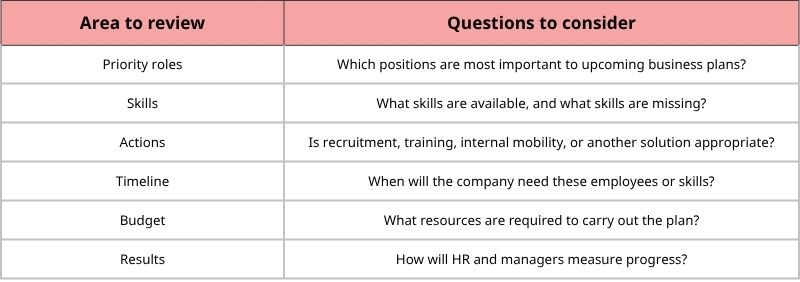
For example, if a company plans to expand its operations in six months, HR can work backward from the expected opening date. This allows time to prepare job descriptions, recruit suitable candidates, and provide any required training.
The plan should also be reviewed when business priorities change. A new project, delayed expansion, or unexpected employee departure may require HR to adjust its priorities.
Regular reviews help keep workforce planning connected to actual business needs.
Workforce Planning in Thailand: Preparing for Future Skills
Workforce planning is relevant to companies in Thailand as industries respond to changing technology and demand for specialized skills.
According to the Office of the National Higher Education, Science, Research and Innovation Policy Council (NXPO), its Thailand Talent Landscape 2025–2029 study projected demand for 1,087,448 high-skilled positions across ten target industries during 2025–2029.
The study identifies workforce demand in areas including aviation and logistics, smart electronics and industrial robotics, digital industries, and next-generation automotive. These findings provide useful context for companies considering their future skill requirements.
The figure represents projected demand across the ten industries covered by the study. It should not be interpreted as the total number of job vacancies or the number of workers missing across Thailand’s entire labour market.
For individual companies, the practical lesson is to review their own business plans and workforce capabilities. The skills required will vary by industry, company size, and business direction.
How Recruitment Supports Workforce Planning
Workforce planning and recruitment are closely connected, but they serve different purposes.
Workforce planning helps a company understand its future staffing and skill requirements. Recruitment focuses on finding suitable candidates for positions that need to be filled.
When workforce planning identifies a hiring need, HR can prepare by defining job requirements, setting a recruitment timeline, and deciding which candidate sources to use.
Working with a recruitment agency may help companies reach candidates with relevant experience, particularly when a position requires specialized skills or language ability.
However, recruitment is not always the only answer. Companies should also consider whether training, internal transfers, or changes to work processes could address some of their needs.
Combining workforce planning with a suitable recruitment strategy helps HR make hiring decisions based on business priorities rather than immediate vacancies alone.
Workforce planning helps companies connect their business goals with the people and skills needed to achieve them.
By understanding future business needs, reviewing current employee capabilities, identifying important gaps, and choosing suitable solutions, HR can prepare for staffing changes in a more organized way.
Companies do not need to build a complex system from the beginning. HR can start by discussing future plans with department managers and reviewing available employee information.
As business needs change, regular reviews can help companies adjust their hiring and development plans. This makes workforce planning a useful part of ongoing HR and business management.
References: NXPO, JobsDB, Imercer
About Us

Personnel Consultant , We’re Japanese recruitment company in Bangkok. We has been in the business of recruiting Thai and Japanese talent for 30 years.
Companies looking for talent & staffing , please contact us through this form Click
Tel.02-2608454
Email : jobs@personnelconsultant.co.th
Contact & Follow Us